
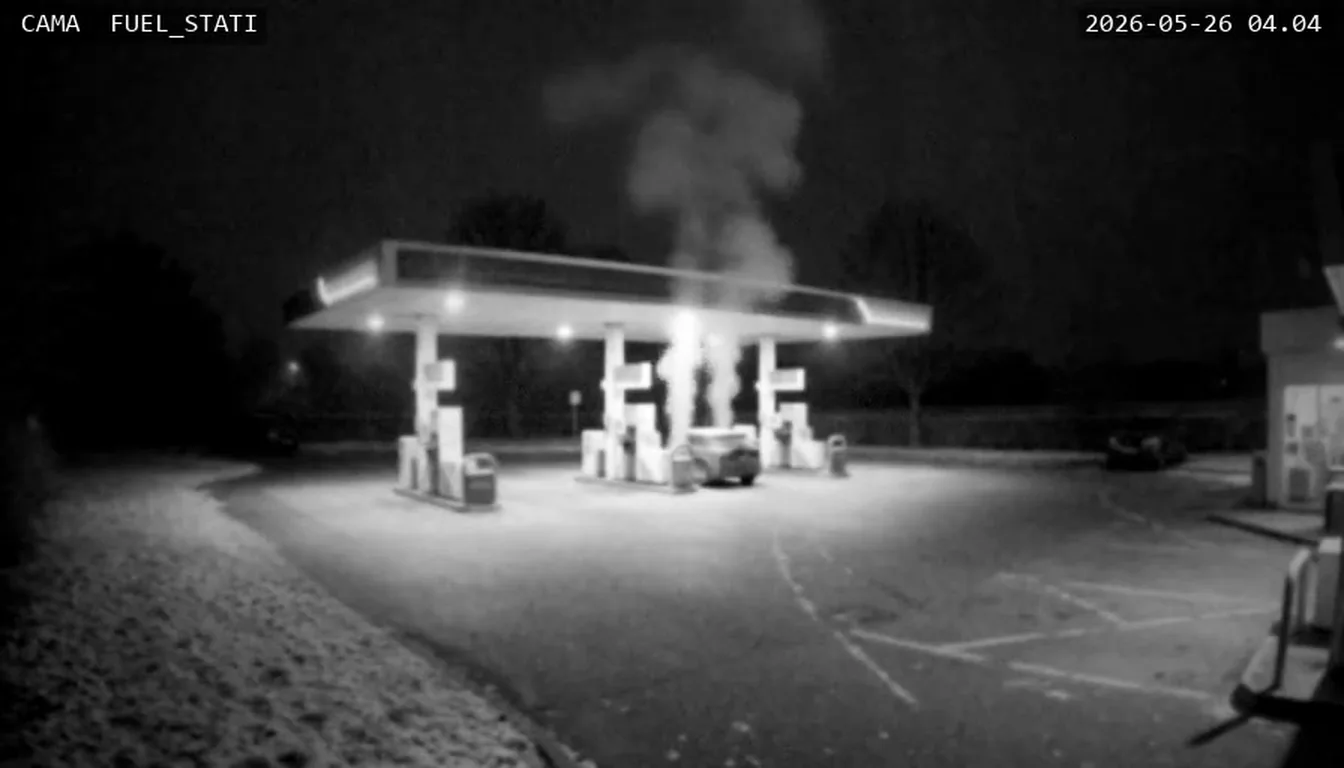
This is not a detection problem. The model saw something grey, moving and rising, and that is exactly what it was trained to see. It is a data problem: the model never learned what not to see.
Look-alikes are the real test
Ask a fire detection model to find a burning pallet in daylight and most will pass. The cases that decide whether operators keep the feature switched on are different:
- steam from vents, exhaust and cooling towers
- fog rolling through floodlights
- dust behind a truck or a loader
- headlight glare and reflections on wet asphalt
- low clouds behind a perimeter fence
These events happen every night, on every site. A real fire happens rarely. A model that is 99% right on fires and wrong on steam twice a night is a model operators turn off.
Why the usual datasets do not catch it
Public fire datasets are built from footage where something is burning. Negatives, if they exist, are mostly "no fire" frames: empty yards, clear sky. Very few contain the hard negatives above, labelled by type, at night, in infrared.
That means a model can score well on its benchmark and still fail on the loading dock. The benchmark never asked the question the site asks every night.
What we measure instead
At Xentim we build hard negatives on purpose: steam and fog clips, each one labelled by type, across day, colour night and infrared night, in the same scenes where we stage smoke events. Dust and glare are next. The point is not to make a model look good. The point is to find out, before deployment, how often it will cry wolf.
The number we care about is simple: false alarms per camera per day. It is the number an operator feels, and the number that decides whether your analytics stays switched on.
Which look-alike causes the most false smoke alarms on your sites?
Questions and answers
Why does steam trigger smoke alarms on cameras?
Steam, exhaust and fog look like smoke to a model: grey, moving, rising. If the training data never contained these look-alikes labelled as "not smoke", the model has no reason to tell them apart.
What is a hard negative?
A clip that looks like the event but is not, for example steam from a vent next to a loading dock. Labelled by type, it teaches a model what to ignore and lets you test how often it is fooled.
How should false alarms be measured?
As false alarms per camera per day, on real footage, at a fixed alarm threshold. It is the number an operator experiences, unlike accuracy scores on a benchmark.
Which look-alikes do your clips cover?
Steam and fog today, in day, colour night and infrared night. Dust and headlight glare are next.
Test it on your own model
A pilot targets the errors your model makes today and measures the result on your own test set.
Talk to us