
How others do it
In France, municipalities install cameras at collection points that catch the moment waste is dumped on their own. Bagnolet, near Paris, is testing four such cameras, moved to new spots every six months. In London, a similar pilot covered housing estates and industrial sites. The common denominator: the guard does not watch hours of empty frame, but gets a ready-made event to assess.
In Poland, the starting point is trail cameras. Sopot has three and plans four more. Dzierżoniów, Nowy Sącz and Tarnów use them in places where rubbish keeps coming back despite being cleared.
Who brought the rubble to the forest
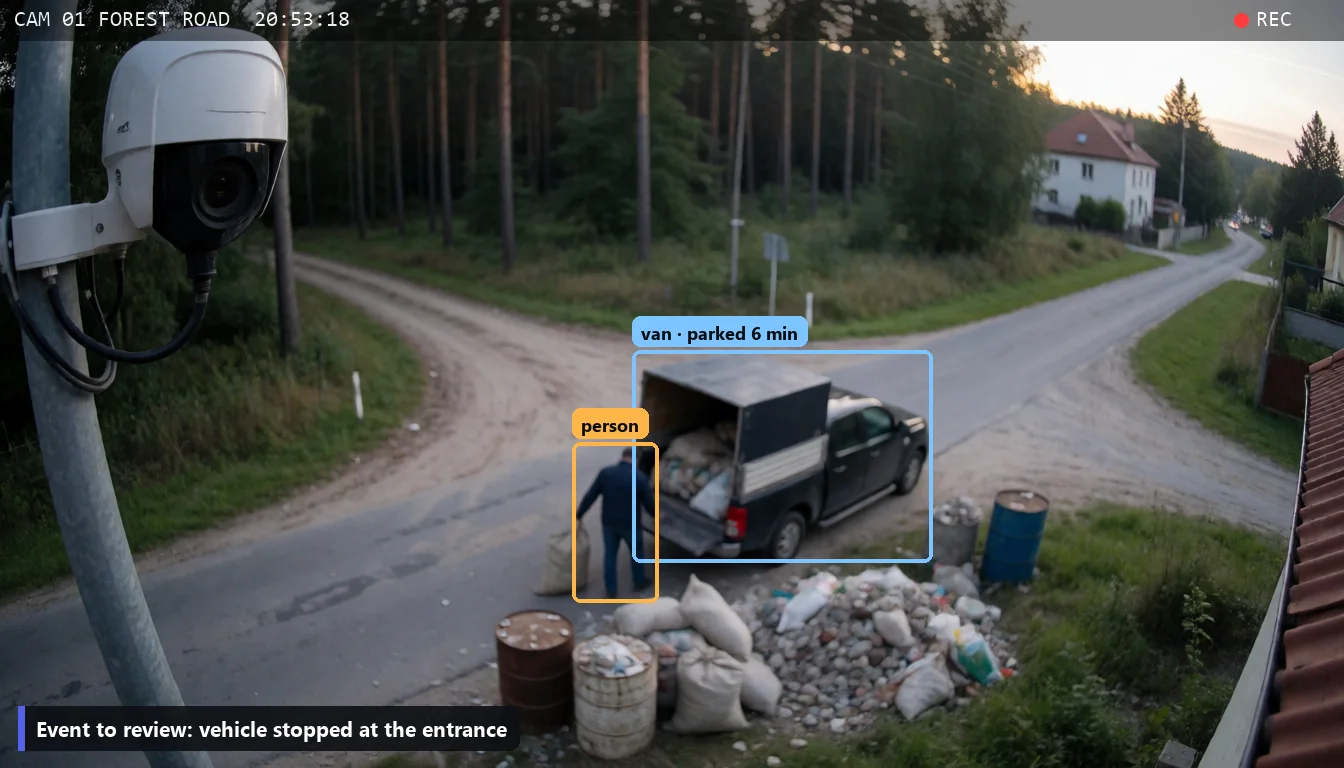
A camera at the entrance to an area from which the municipality hauls away a container of waste every month. Instead of reviewing a week of footage, the guard types:
delivery van with an open bed at the forest entrance
and gets a few clips with the time. From there the usual procedure runs: identifying the owner, a fine, the duty to clean up.
Hazardous waste
Drums, canisters, batteries and asbestos cement are the most expensive kind of dump, because disposal costs many times more than ordinary collection, and the risk to people and the ground is real. In Canada, cameras on garbage trucks photograph the contents of bins and flag gas cylinders and batteries, after which the property owner receives a photo of their own waste by mail. Here the same idea can start more modestly: an alert when a vehicle stops at the gate of a waste collection point after closing and someone is unloading something from it.
When the waste was actually collected
Disputes over whether a pickup happened cost officials and companies a mass of correspondence. A camera at the bin cluster records the garbage truck arriving. The question “when was there a truck at the shelter on Lipowa Street” gives a date, a time and a frame. A complaint can be upheld or rejected in five minutes.
What you get
The guard assesses ready-made events instead of reviewing hours of footage. Less clearing of the same spots at the municipality’s expense.
A culprit identified means a fine and cleanup costs on their side, not on the budget’s.
Hazardous waste caught before it reaches the ground or catches fire in a container.
Honest about the limits
Night, rain and a camera set at a bad angle can break any system. A license plate from a general camera is often unreadable, so where the number matters you need a camera positioned for plates. Nor do we promise the model will recognize the type of waste. It recognizes the vehicle, the person, the place and the time, and that is usually enough to keep the case from being dropped.
See it on your own footage
The demo takes up to an hour and runs on footage from your cameras.
Book a demo