
What large airports do
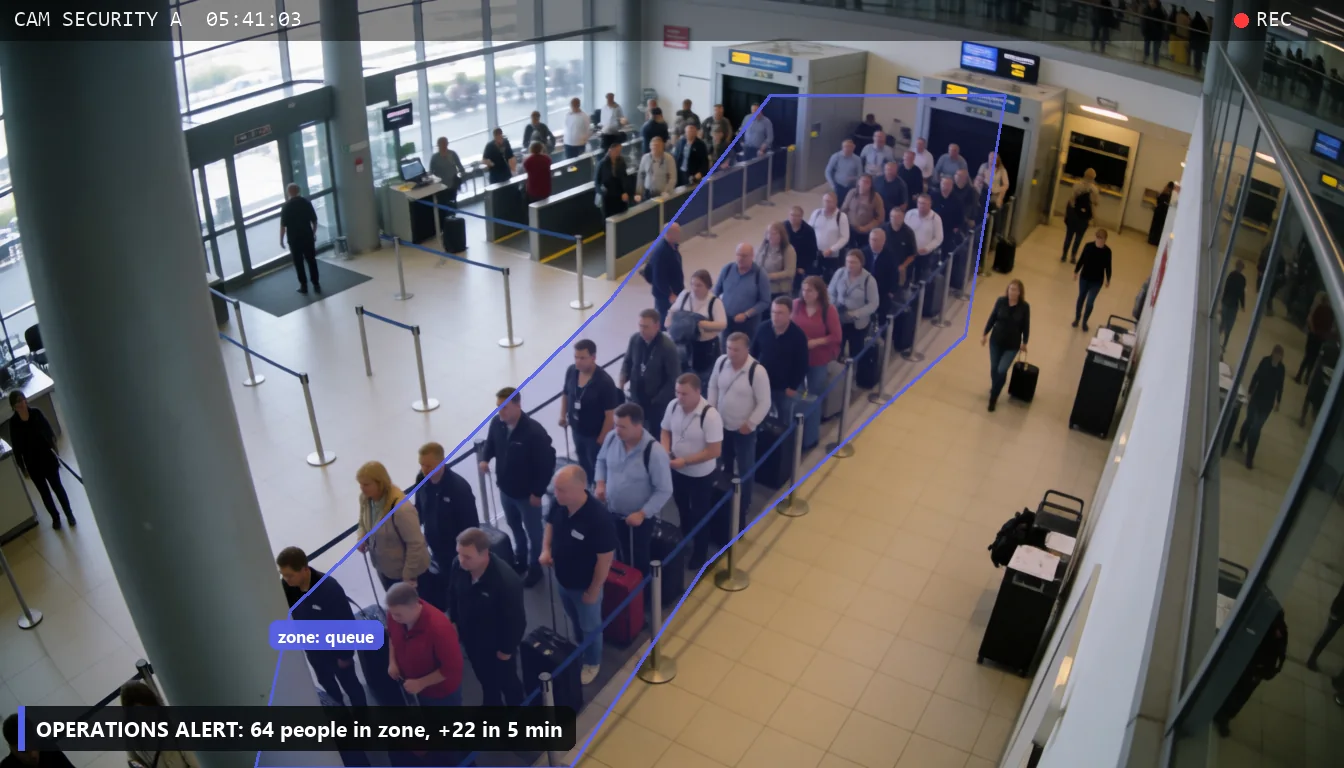
London Gatwick measures waiting time and occupancy of the screening zones in both terminals to plan when to open lanes. On the aprons, cameras track an aircraft’s ground handling: fuelling, catering, door closing, and report when one of the steps falls behind. In Abu Dhabi, video analytics watches for abandoned baggage. These are not experiments, but everyday operational work.
A smaller regional airport does not need a system worth millions. It needs to know three things: where a queue is building, where something is standing too long, and who is where they should not be.
Congestion at security and check-in
We mark the queue zone. The system counts people and measures how long they stand in it. When the number crosses a threshold, the shift manager gets a signal before the queue blocks the hall.
The daily report shows the same thing in numbers: when the peak starts, how long it lasts and how many lanes are actually needed on a Monday versus a Saturday.
The terminal kerbside
The “kiss and fly” zone works as long as cars drive off. A car that stands there for ten minutes blocks the lane and creates a jam reaching back to the roundabout. A dwell rule in the zone gives security a signal with a frame, instead of counting on a patrol that happens to pass by.
Restricted zones and the apron
A person or a vehicle in a zone where no one should be at that hour is a classic perimeter alert. Large airports use thermal cameras for this, because the apron is vast, and engine blast and animals can fool sensors on the fence.
Abandoned baggage
This is one of the hardest scenarios, because in a hall full of people a bag keeps disappearing behind someone’s back. We treat it as a topic to verify during a two-week trial, in a chosen, quieter zone, rather than a feature we promise up front.
What you get
Every minute a passenger spends in the security queue is a minute they do not spend in the retail area. A smooth kerbside also means fewer late passengers and fewer carrier complaints.
You open lanes according to actual traffic, not a schedule from a year ago.
A response to a person in a restricted zone at the moment of entry. Less crowding in the hall, and so an easier evacuation.
Why local processing matters here
The image from an airport is data no one wants to send to an external cloud. The analysis runs on a device inside the airport’s network. We do not recognize faces: we count people and measure time, we do not establish identity.
See it on your own footage
The demo takes up to an hour and runs on footage from your cameras.
Book a demo