
How the Danes did it
At the Køge Nord railway station near Copenhagen, 25 cameras serve a car park of 650 spaces. A single camera sees up to 90 bays. The driver gets information about free spaces on signs by the car park, in the town and by the motorway. The vendor reports accuracy above 98 percent. No one drilled a single hole in the surface.
Free spaces in your car park
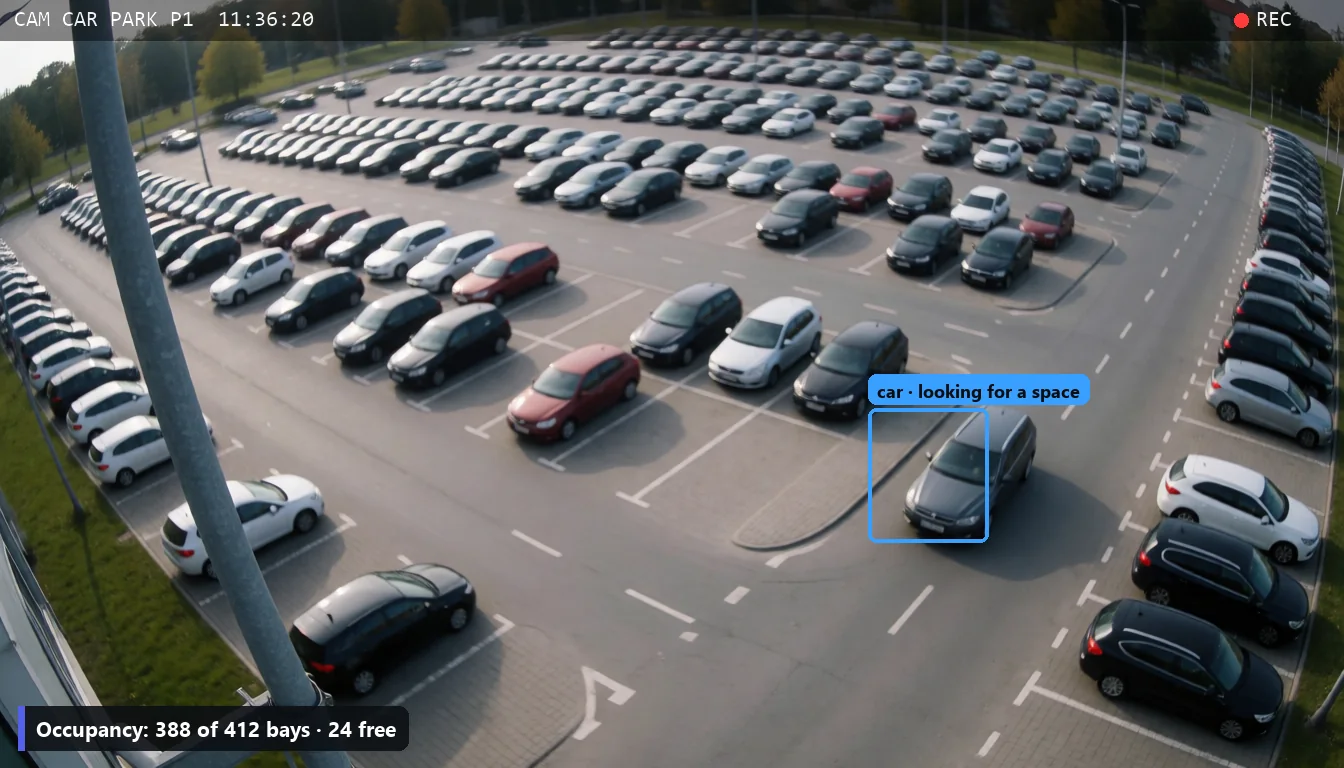
We mark the bays on the image, and every few seconds the system checks which are occupied. The result is a simple number for each level or sector, which can be shown on a sign at the entrance, in an app or in a report for the operator.
how many spaces were free on level -1 on Friday at 17:00
After a month you know which hours the car park is full, which sectors stand empty and whether it pays to set aside spaces for season tickets.
Congestion at the entrance and at the gate
The same counting works for a queue. A line of cars before a shopping centre barrier, or trucks before a plant gate, is a loss on both sides: the customer drives off, the driver loses the unloading window. When there are more vehicles in the approach zone than we set, and they stand longer than a few minutes, staff get a signal to open a second lane or route traffic through another gate.
A vehicle that stopped where it should not
In Norwegian tunnels, cameras have detected stopped vehicles, pedestrians and wrong-way driving since the 1990s, because a call from a driver usually comes in a few minutes after the event. In Colorado, sensors on motorway ramps notify the traffic centre 2 to 3 seconds after a wrong-way entry, and in the first months of testing they helped prevent four such events. There thermal imaging was used, which is worth knowing: in bad weather an ordinary camera sees worse.
At the scale of a site, the same mechanism watches the garage entrance, the exit ramp and the emergency lane.
What you get
A customer who finds a space right away walks into the shop instead of driving off to a competitor. Occupancy data lets you price season tickets and peak hours sensibly.
No sensor in every bay and no breaking up the floor. In Køge, one camera per about 26 spaces was enough.
A stopped vehicle in a tunnel, on a ramp or going the wrong way, reported in seconds, not after a call from another driver.
What can go wrong
A pillar hiding half the bays, a camera at a sharp angle, snow on the lines, a night with no lighting. Each of these lowers accuracy, and none of them shows in a sales brochure. That is why we first count spaces on your footage and compare the result with what the naked eye sees.
See it on your own footage
The demo takes up to an hour and runs on footage from your cameras.
Book a demo