
Gdańsk, 3 September 2026
The truck drove onto the crossing just as the barriers began to descend and was trapped between them. The oncoming train, running Gdynia Główna to Zielona Góra, slammed into the trailer. No one died, the driver went to hospital, and there were around 250 to 300 people on the train. The whole incident was recorded by a crossing camera, as happens at most of the roughly 1,300 crossings in Poland that have surveillance.
The cameras record, but they wake no one
Surveillance at crossings mainly serves to reconstruct an incident and to prosecute drivers who go around the barriers. That matters, but it is after the fact: the recording shows what happened, it does not warn that it is happening right now.
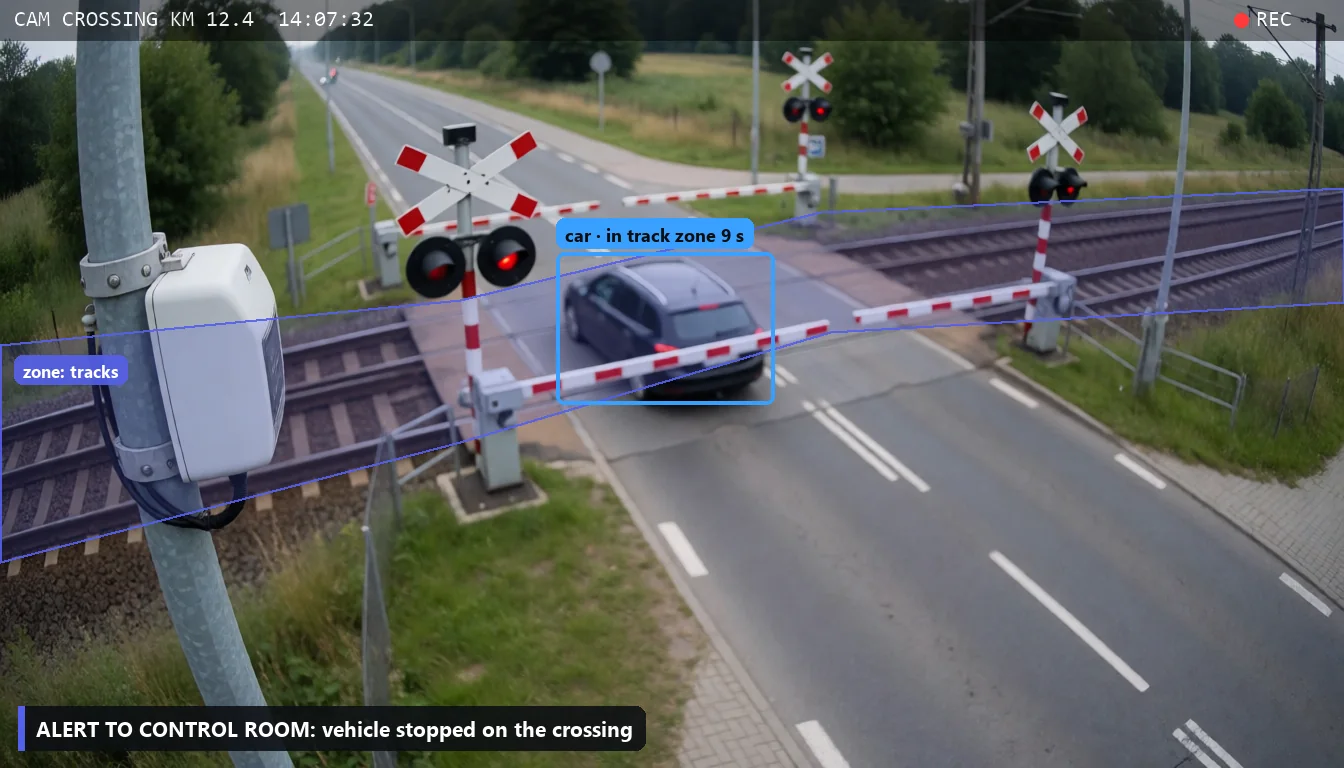
A vehicle stopped in the track zone
On the image we mark the track zone within the crossing. The system recognizes vehicles and measures how long each one stays in it. An ordinary crossing takes a few seconds. If a car stays longer than we set, an alert goes to the control room.
The signaller does not hunt for the right view and does not guess whether it is a shadow. They see the frame, the camera number and the time. From there they act according to the unit’s procedure.
We tested it on real footage
We took footage from a crossing where a truck got stuck on the tracks, marked the track zone and ran the image through Xentim. The system recognized the stationary vehicle in the zone and raised an alert about 8 seconds before the train hit. Eight seconds is no miracle and no guarantee of avoiding an accident. It is the difference between a signaller who happens to be looking the other way and a signaller who, at that very moment, has on screen a frame with a camera number and the caption “vehicle stopped in the track zone”.
Everything is computed on the image from a camera that is already up there, locally, without sending the footage anywhere outside.
Poznan Wola, 26 October 2026: 30 seconds
PKP Polskie Linie Kolejowe published footage from a level crossing in the Poznan Wola area. A tanker truck got stuck in traffic between the barriers. The driver got off the tracks at the last moment, and moments later an InterCity train, Mockava to Szczecin Glowny, passed through. The camera clock shows the barriers down at 16:42:08 and the train on the crossing at 16:42:38. Thirty seconds in which the camera saw everything and warned no one.
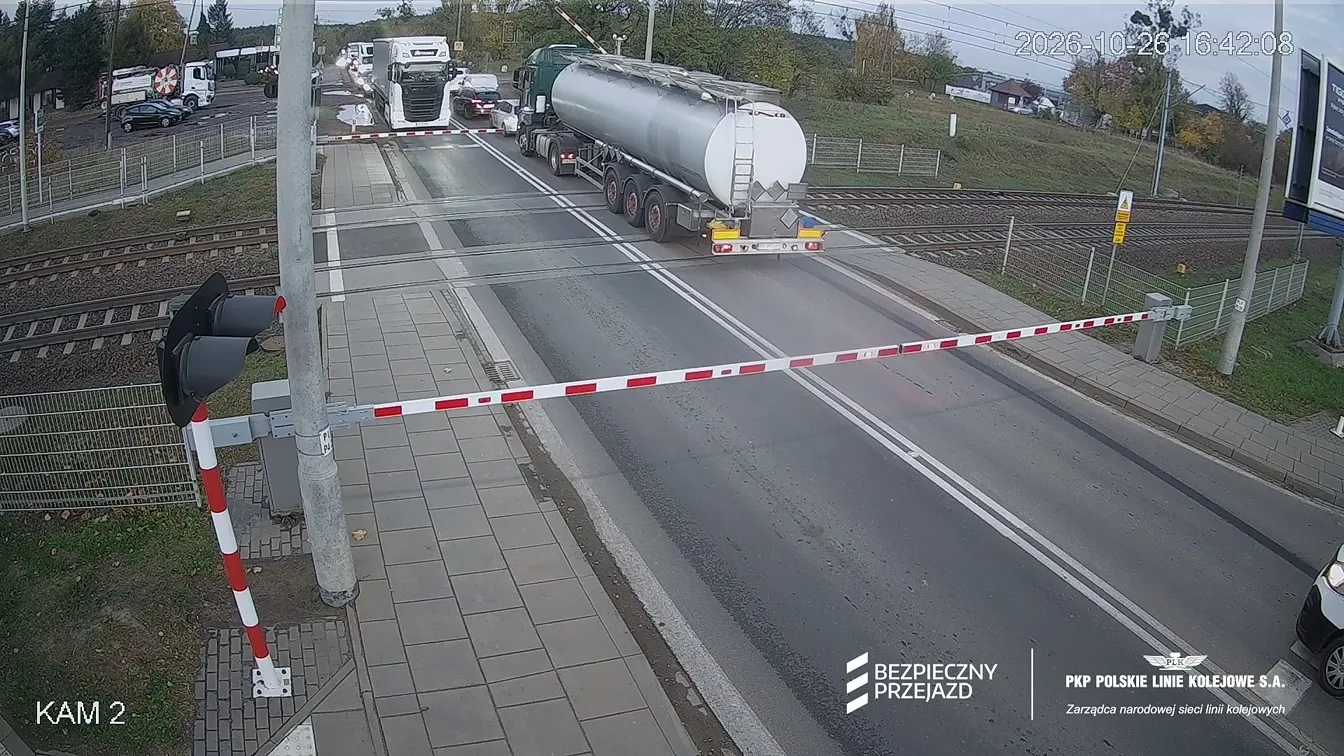
What an alert could have done in those 30 seconds
A train running at 100 to 120 km/h needs roughly 500 to 700 metres to stop under emergency braking. By the time the driver can see a vehicle on the crossing, it is usually too late to stop in front of it. We calculated what an alert from the camera changes. Assumptions: an alert after the vehicle has stood in the track zone for 5 seconds with the barriers down, 2 seconds of driver reaction, emergency deceleration of 0.9 m/s². We do not know the actual train speed on this section, so we calculated two cases.
- Alert to the signaller, who sends a Radiostop emergency call (the train gets the signal about 15 seconds before the crossing): at 100 km/h the impact happens at about 40 km/h, at 120 km/h at about 66 km/h. Impact energy grows with the square of speed, so that is about 16% and 30% of the energy of a full-speed impact.
- Alert integrated with railway systems and passed to the train automatically (signal about 25 seconds before the crossing): in both cases the train stops before the crossing.
Xentim provides the detection and the alert: it recognises a vehicle standing in the track zone and immediately sends an event with the frame, the camera number and the time. The alert goes out over standard channels (API, webhook, SIA DC-09), so it can be connected to whatever system the infrastructure manager uses: the signaller’s console, train radio, a safety management system. Integration with the chosen system is the next step of a deployment, designed together with the operator. That is where the full value is: an alert that goes nowhere changes little. Camera, detection and railway systems connected into one integrated safety system turn 30 seconds of watching into 30 seconds of action. The figures above are calculations on stated assumptions, not a measurement, but they show the order of magnitude: fifteen seconds earlier is the difference between a full-speed collision and a much slower one, or none at all.
A person in the track zone
The same mechanism works for people. The strip along the tracks away from the platform and away from the crossing is a place where no one should be. A British infrastructure manager is testing this kind of detection on cameras it already has, precisely so it does not have to build a new sensor network.
Sidings and rolling stock after hours
Stabling yards are large and dark, and a painted-over train comes to light in the morning, when it is meant to go out on a route. The rule “a person on a siding between 22:00 and 5:00” turns recording into a signal for security at the moment a response is still possible. The British operator Southeastern brought twelve depots under this kind of analytics, including five with no permanent staff.
Replaying an event
truck on a crossing with the barriers down
Instead of copying hours of material from several cameras, you get the matching clips with the time and the vehicle’s path. The material for the inquiry is ready in a quarter of an hour.
What you get
Word of an obstacle reaches a person in seconds, not when someone happens to glance at the view.
Establishing the course of an event in a quarter of an hour. Less graffiti to remove and fewer trains taken out of service.
A train that goes out on a route in the morning instead of to the wash is a run that happened.
Where Xentim fits in this system
Xentim is the detection and alert layer on the cameras that already stand at crossings and along the tracks. It does not replace certified signalling equipment or radar and lidar obstacle detection. It complements them with vision where they are missing and becomes one element of an integrated safety system. The connection to the infrastructure manager’s systems, from the signaller’s console to train communication, is designed together with them, following their procedures and approval requirements.
- Super Express: Intercity train hit a truck at a crossing in Gdańsk (3.09.2026)
- Super Express: drove onto the crossing as the barriers came down, 42-year-old charged
- PKP PLK, Bezpieczny Przejazd: tanker between the barriers in Poznan Wola (footage, 27.10.2026)
- Trans.info: surveillance at railway crossings in Poland (2020)
- Security World Market: video analytics at Southeastern depots
- Railway Gazette: lidar at a level crossing
See it on your own footage
The demo takes up to an hour and runs on footage from your cameras.
Book a demo