
What we know from deployments
The best-documented example comes from forests, not halls. California’s ALERTCalifornia network is 1,211 cameras on hills. In 2024 the cameras caught 1,668 of 7,553 fires in the state fire service’s area of operations, and 636 of them, that is 38 percent, before anyone called the emergency number.
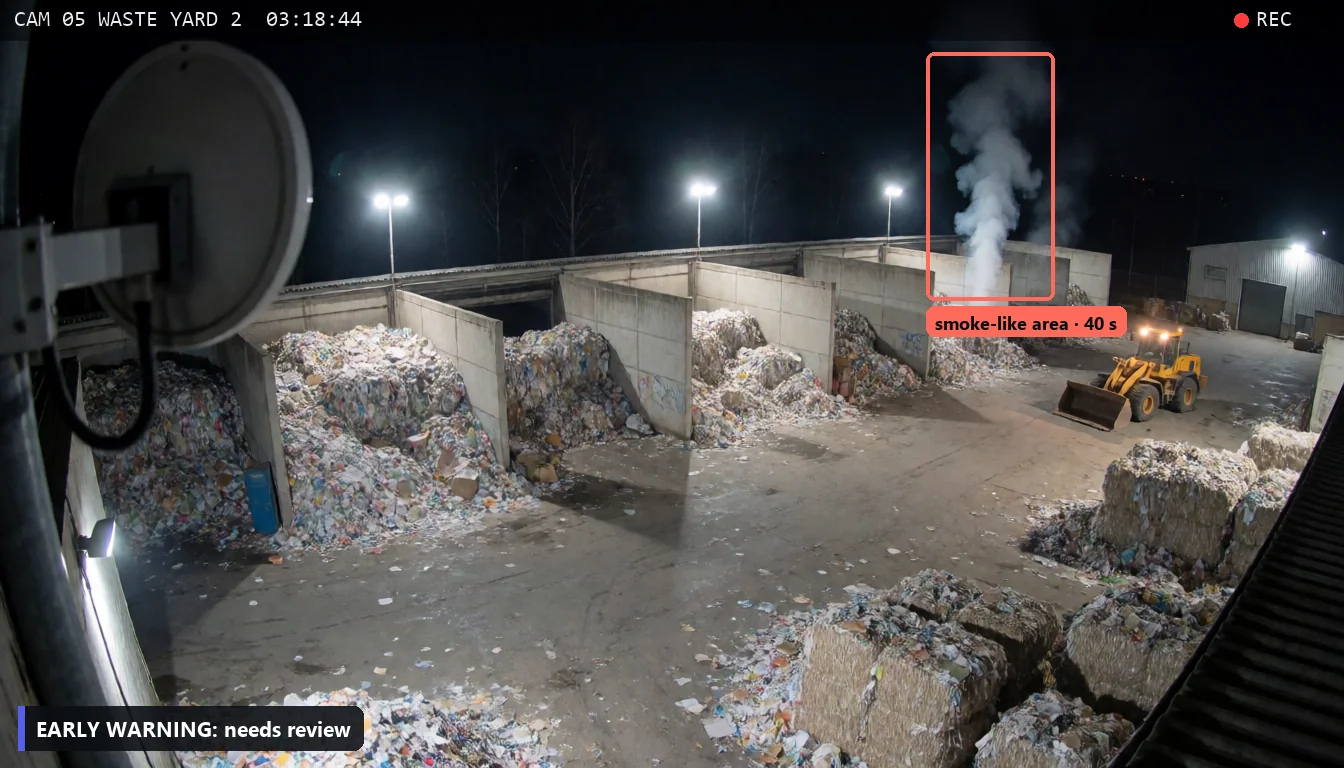
In industry, video smoke detection is used by incinerators and waste processing plants, where ordinary detectors lose out to dust, moisture and the height of the bunkers. The reason is prosaic: lithium batteries in waste ignite on their own, and a fire in a sorting plant means weeks of downtime.
A scenario for your site
We do not start with the whole plant. We pick two or three places where fire is most likely and most costly: the waste yard, the forklift charging station, the packaging store. There we set up smoke detection on the image and spend two weeks checking what the system reports.
The warning goes to a person: security, the shift manager or the on-call phone. It is they who decide whether it is smoke or exhaust vapour from a loader.
False alarms are part of this technology
In California the software had to be taught not to report steam from geothermal power plants. Dust, fog, exhaust and sun in the lens do the same in a hall. That is why we do not promise catalogue-grade accuracy. A two-week trial shows how many reports a day you will get and how many of them are accurate, and only then do you decide whether it makes sense.
What you get
Minutes of lead time in a place where a detector under the roof reacts last. A person gets an image, not just a signal, so they know where to run and with what.
A fire stopped in a single bay is not the same as a burned-out line and a month of downtime.
A plant that is running fulfils its contracts. With waste and recycling, downtime also means contractual penalties for deliveries not taken.
What it is not
Xentim is not a certified fire alarm system and does not replace one. It does not have the approvals required by fire regulations and by the insurer, and it does not trigger suppression or smoke extraction. Specialized fire cameras recognized by certifying bodies exist, and if regulations require them, they are the right choice. Xentim is an extra pair of eyes on the cameras you already have.
See it on your own footage
The demo takes up to an hour and runs on footage from your cameras.
Book a demo